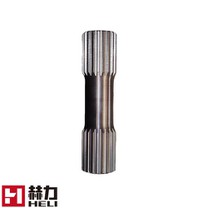
The longwall shearer is the powerhouse of modern underground coal mining, and its cutting unit (also known as the ranging arm and cutting head) is the most critical component. It is the part of the machine that directly interacts with the coal seam, responsible for fragmenting the mineral and loading it onto the Armored Face Conveyor (AFC).
1. Structural Design of the Cutting Unit
The cutting unit is a complex assembly designed to withstand extreme mechanical stress while maintaining high operational precision. It primarily consists of the following elements:
A. The Ranging Arm
The ranging arm is a robust housing that contains the gear transmission system. It is pivoted at the main body of the shearer, allowing it to swing vertically via hydraulic cylinders. This movement enables the machine to adjust to varying seam thicknesses and to cut both the roof and the floor of the coal seam.
B. The Cutting Drum
Attached to the end of the ranging arm, the drum is the actual tool that breaks the coal. It is typically a cylindrical steel shell with a helical vane structure.
Vane Design: The spiral vanes act as a screw conveyor to move the cut coal toward the AFC.
Pick Boxes and Picks: Hardened steel or tungsten carbide "picks" are mounted in boxes along the vanes. Their arrangement (the "lace" pattern) is optimized to reduce dust and maximize coal sizing.
C. The Transmission System
The cutting unit houses a high-power electric motor, often ranging from 500 kW to over 1000 kW. This power is transmitted through a series of reduction gears (planetary and spur gears) within the ranging arm to provide the high torque necessary for the drum to penetrate hard coal or rock partings.
D. Internal Water Spray System
To mitigate the risk of methane ignitions and to control respirable dust, the cutting unit features an internal cooling and suppression system. High-pressure water is channeled through the ranging arm and sprayed directly onto the pick tips during rotation.
2. Operational Application
In a typical longwall operation, the shearer moves back and forth along the coal face. The cutting unit performs several vital functions:
Cutting and Fragmentation: As the drum rotates, the picks impact the coal face, creating a "web" of cut coal.
Loading: The helical shape of the drum vanes ensures that as the coal is broken away, it is mechanically pushed onto the conveyor belt behind the shearer.
Horizon Control: Operators (or automated systems) adjust the height of the cutting unit to follow the natural undulating boundary between the coal and the surrounding rock, ensuring maximum resource recovery and minimum dilution.
3. Modern Advancements
Recent designs have focused on intelligent sensing and durability. Modern cutting units are now equipped with vibration sensors, temperature monitors, and acoustic emission devices to predict pick wear or mechanical failure before it happens. Furthermore, the integration of "memory cutting" technology allows the cutting unit to automatically replicate a successful path, significantly reducing the need for personnel to be near the hazardous dust zone.
Conclusion
The cutting unit is the "business end" of the longwall shearer. Its design must balance raw power with sophisticated control systems. As mining moves toward deeper seams and more autonomous operations, the reliability and efficiency of the cutting unit's gear geometry, material strength, and dust suppression systems remain the focal point of underground
Shaanxi Heli Mechanical Engineering Co., Ltd
website: www.heli-mining.com
email: yun.liu@helimechanical.com